

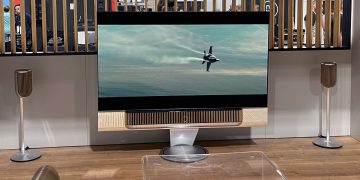


Samsung’s The Wall has been shown for several years now at shows, originally as a prototype technology display. It fits into a relatively new category that is being referred to as “Resimercial.” – A product that is sold not just in commercial settings but also into high end residential. The name – The Wall – implies the size, and the size is way larger than traditional LED/LCD TVs. The technology behind Samsung’s Wall is MicroLED.
More Sizes of The Wall Now Available
Samsung keeps expanding the number of sizes for The Wall. Originally the low res version (1080p), started at 110” diagonal, but now starts as low as 75” and 88” diagonal. Small units are fine, but, the real action is the larger sizes: The 146” is probably the most iconic. Check out this 146” in a bedroom. (I’m so jealous!). But a 219” or a 291”? We’re going way beyond amazing. I’ve been following The Wall’s development, and models for at least 4 years now.

While the home market (except for high end “resimercial”) would be primarily interested in the still expensive 110” and 146” diagonal Wall models, keep in mind the larger pixel sizes, limits the smallest sizes, 75”, 88”, 110” diagonal, etc, to 2K resolution, while there are both a 4K, and a 2K version of the 146” diagonal (and I assume the new 150”.
In addition, larger sizes such as 219” and 292” diagonal come in 4K or 8K resolution and can apparently (now or in the future) support 16K!
Now we’re talking seriously large. (146” diagonal, means about 6 feet tall, and over 10 feet wide, but the 219” model – wow: works out to almost 17 feet wide… and roughly 9 feet tall.
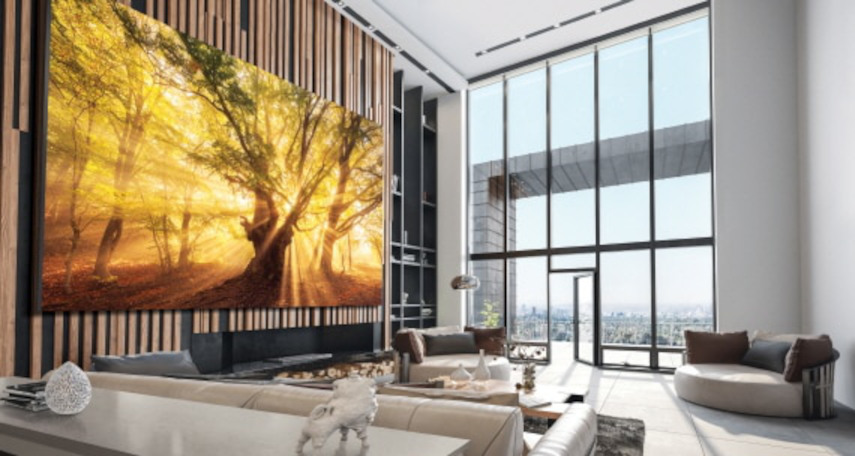
Whether you or yours have a home location demanding a Micro LED system like the Wall, or not, the commercial applications are almost endless, thanks to models, which in size are competitive with projectors, but drastically brighter! While few projectors can top 300 or 400 NITS brightness on typical screens, The Wall can push out something approaching, (maybe exceeding) 1500 NITS, which is also higher than the 1000 NITS standard for full HDR performance – no need to compromise, with tone mapping.
Besides the relatively simple installation, the Wall has several important features built in, including a speaker array, and a full blown controller for managing picture quality, sources, and more. Basically just feed it a source – it’s got what you need to put up a large image and solid sound capabilities.
Unfortunately, I could not make the CEDIA show in Dallas this year – we’re out of Florida, and were fortunate to be a bit north of the hurricane’s landfall. But our airports closed. As I’ve said, I’ve seen The Wall previously at shows, but would have liked another chance to look closely, and also hear the sound quality.